
Lower Paxton City Directory Collections
Historical resident research in Lower Paxton Township needs a careful shelf check. Residents often used Harrisburg as a mailing city, while Linglestown, Paxtonia, and Colonial Park developed in different periods. A Harrisburg title can include nearby towns or a street section, but the Historical Society cautions that coverage differs by volume. An absence in one book is not proof that a Lower Paxton person was absent from the area. Confirm the title page, suburb coverage, and the part of the volume being searched.
| Collection | Years | Where held | Access |
|---|---|---|---|
| Harrisburg city directories | 1839, 1842-43, 1852, 1856, 1858, 1860, 1863-64, 1866-67, 1869, 1871-1947, 1949-56, 1958-76, 1979-82, 1986-99 | HSDC Alexander Research Library | In person or research request; check each volume's geography. |
| Harrisburg city directories | 1861-1901 | DCLS East Shore Area Library, Colonial Park | On-site microfilm. |
| Patriot-News | 1946-2015 | DCLS East Shore Area Library | On-site microfilm for notices and local context. |
| HSDC church, cemetery, will, and Orphans' Court materials | Varies by collection | HSDC Alexander Research Library | Collection research or paid staff research. |
The listed HSDC runs are noncontinuous, and no verified full digitized Lower Paxton or Harrisburg directory run was located. The historical shelf is still strong because it preserves long stretches across the nineteenth and twentieth centuries, but the exact year and geographic reach matter every time.
Note: Record the title, publication year, page, and stated coverage before relying on a city directory entry as historical evidence.
Lower Paxton City Directory Titles
Harrisburg directory titles matter because postal labels and municipal borders do not match neatly here. Linglestown was founded in 1765, while Paxtonia and Colonial Park developed in the twentieth century. A household in Lower Paxton might appear under a Harrisburg-oriented volume, a village name, a road description, or not at all if the compiler did not include that area. Search a surname in nearby years and inspect the directory's introductory material before concluding that a family moved.
The Township's documented history also changes where early work begins. Paxton Township was part of Lancaster County before Dauphin County formed in 1785, and Lower Paxton took its name in 1767. For an early family, church, cemetery, land, and county sources may be more useful than a city directory. Later suburban addresses can sit on land once described by a farm, road, or legal description rather than a present subdivision name.
| 1729 | Paxton Township begins within Lancaster County. |
|---|---|
| 1765-1767 | Linglestown begins as the Town of St. Thomas, and the remaining township becomes Lower Paxton. |
| 1785 | Dauphin County forms, creating the county-era jurisdiction for later Lower Paxton records. |
| Twentieth century | Paxtonia and Colonial Park develop, adding newer place names to the historical search vocabulary. |
A view of the Township history resource is captured below. Its local timeline helps explain why a directory title may use a different place name than the modern township.
Use that history as a jurisdiction and place-name check, not as proof that a named person occupied a particular address.
Lower Paxton City Directory Shelf
The Dauphin County Library System collection identifies East Shore Area Library in Colonial Park as the local microfilm access point for Harrisburg directories from 1861 through 1901. That same setting holds Patriot-News microfilm from 1946 through 2015, which can supply an obituary, marriage notice, civic item, or property context after a directory lead. It is an on-site research channel, so a reader who cannot find the needed volume online should plan around the library rather than assume the run is unavailable.
Begin with the directory year nearest the known address or event. If the person is not listed, test surname variants, initials, the spouse's name, and the next available year. The newspaper layer is best used to corroborate a lead, not to turn a short notice into a claim about a whole household.
The East Shore collection page is shown here as the local access point for microfilm holdings.

Its value is the physical research route: a directory entry can be checked against nearby newspaper dates without leaving the same local collection system.
HSDC's Lower Paxton City Directories
The Historical Society of Dauphin County's Alexander Research Library holds the broadest documented Harrisburg directory shelf, from 1839 through 1999 in the listed runs. Its archives add family, business, school, church, organization, government, military, map, ledger, and clipping material. Church records for many county churches reach into the 1700s, and the library lists cemetery inventories, Will Book Extracts from 1785 to 1827, and Orphans' Court Extracts from 1785 to 1817.
Researchers who cannot visit may submit a query for paid staff research. The Alexander Library is at 219 South Front Street in Harrisburg, with listed research hours Tuesday through Friday from 1:00 to 4:00 p.m. and on the second Sunday. Members enter free, while nonmembers pay an admission fee. Call 717-233-3462 or email library@dauphincountyhistory.org before a visit if a particular volume or archive group is essential.
The Historical Society's directory holdings page appears below.
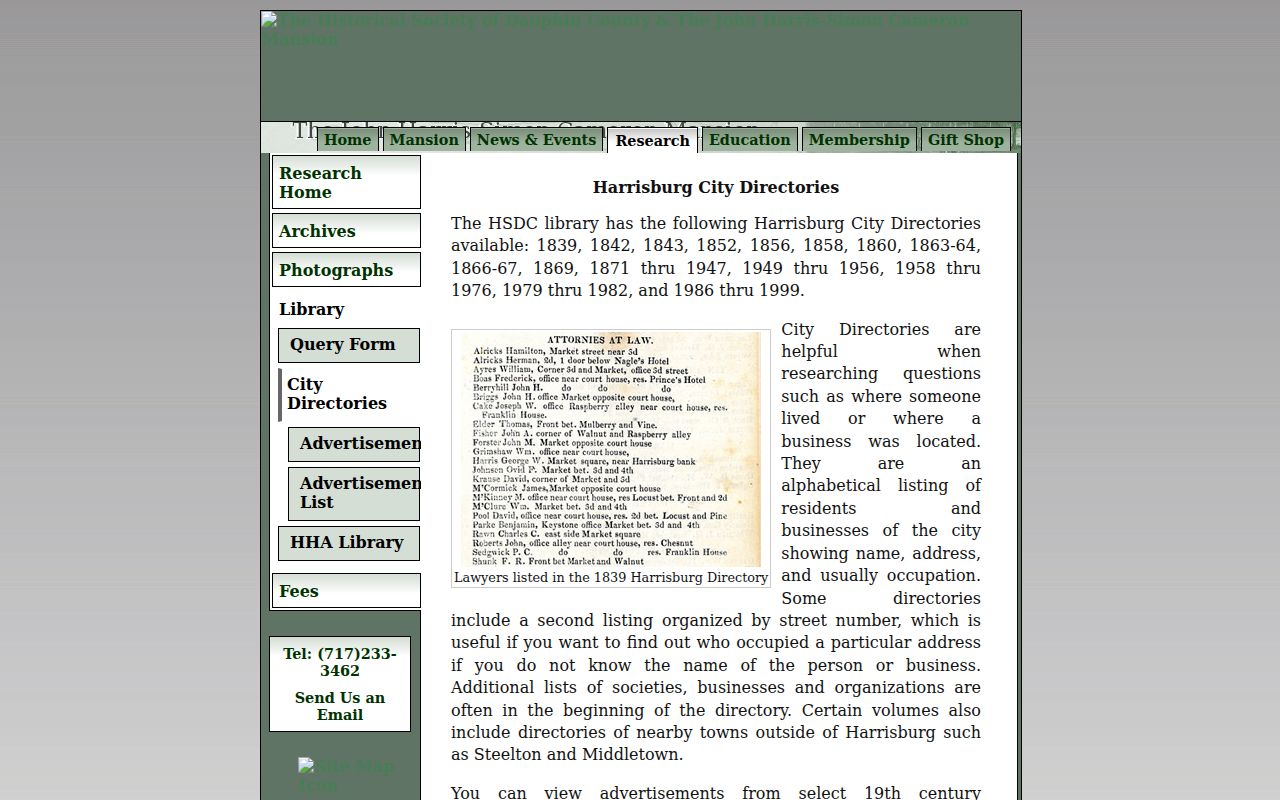
The holdings description supports a collection search, but it is not a searchable resident result and should not be read as one.
Reading a Lower Paxton City Directory
A Harrisburg city directory normally lists a resident or business name, an address, and usually a work or business description. Some volumes may add a street-number section that runs in reverse, from address to occupant. The particular volume controls what is present. Photograph or note the abbreviation key and the opening pages before interpreting initials, business abbreviations, or geographic coverage. An annual listing shows what its publisher compiled, not ownership, household membership, voting status, or an exact moving date.
| Name | The resident or business name as printed; preserve initials, suffixes, and spelling. |
|---|---|
| Address | The listed location, which needs a coverage check before it is tied to Lower Paxton Township. |
| Work or business line | Usually a work or business description when the compiler included one. |
| Street-number section | A possible address-to-occupant listing; verify that the year has this section. |
| Front matter | Organizations, businesses, and the publisher's abbreviations can explain the entry. |
- Criss-cross directory
- A directory section arranged by street number instead of surname, useful only when the target volume contains it.
- Householder index
- An alphabetical name listing that can lead to a listed address; it does not prove every person in a home.
- Abbreviation key
- The publisher's explanation of shortened terms, usually near the front of a volume and worth recording with the entry.
Lower Paxton Directory Gaps
Do not fill a gap with a story. A missing listing can reflect the geographic scope of that edition, a spelling variation, a move, a business-only listing, or the absence of a published volume. The safer response is to compare adjacent directory years, then test an independent source such as a deed, an estate file, a census record released on the federal 72-year schedule, or an obituary and cemetery collection.
HSDC has select nineteenth-century directory advertisements digitized through its Rawn Journal Project. Those advertisements can place a business or address in local context, but they do not prove a person lived there. The Society's research library also holds original deeds, certificates, yearbooks, maps, and clippings that can help when a printed directory ends.
Lower Paxton City Directory Tracing
Trace a household one printed year at a time. Start with a known address, deed, or surname, then copy the entry exactly and check the adjacent years. A move, a new initial, a changed business line, or a disappearance is a lead to test. Pair the printed address with the closest available census to examine household composition, then use the Recorder's deed index for owner transitions and HSDC or Patriot-News material for obituary, church, and probate leads.
- Find the first relevant printed entry and record the title, year, page, name, address, and every abbreviation.
- Search the preceding and following available volumes for the same spelling and plausible variants.
- Check the street-number section when the volume has one, then compare the address with the township and postal geography.
- Pair the directory year with a released federal census and a recorded deed or estate lead.
- Use newspaper, cemetery, church, or probate material to test why the listing changed or ended.
A last household address can be a useful lead for an heir inquiry when it is paired with an obituary, a public estate docket, and later recorded transfer information. It is not enough, by itself, to identify heirs or prove a present address.
Note: Treat a directory disappearance as a question for another source, not evidence that a person died or left Lower Paxton.
Lower Paxton Directory Companions
When directories end, HSDC's church, cemetery, manuscript, photo, map, and local-history collections provide documented alternatives. Its photo archive spans from the 1850s to the present, while the Allied Pix newspaper collection covers 1952 through 1994. Use a dated item to establish a road, business, school, church, or development context. Do not infer that every person shown in a photograph lived at that address.
The Alexander Research Library holdings support that broader evidence path. The research library can also handle requests by staff when an in-person visit is not practical.
The Township Historical Commission resource is pictured here.
The Commission's public history resources add a local route to historic sites and Linglestown walking-tour context, rather than a current resident roster.
Note: A photograph or archive finding needs a date and source context before it supports a resident or address conclusion.
Lower Paxton City Directory Archives
The Pennsylvania State Archives is the next documented route for statewide birth and death indices, census, naturalization, land, and map research. It does not hold every county original, so match the question to the keeper. For a Lower Paxton immigrant ancestor, use its name, date, and place research guidance, then ask Dauphin Prothonotary or HSDC about local naturalization material.
State archival research can bridge a directory clue to a record series, while the county Recorder and Register of Wills supply the better local path for deeds, estates, marriages, and county-era material. Modern address-keyed ownership research belongs on the Lower Paxton street directory, where parcel and deed methods are treated in detail.
The State Archives research portal is pictured here.

Archive guides extend the trail beyond a single printed listing, but each record group has its own coverage and access conditions.